
I really don’t understand why there’s not more hype around Deep Research. Given how easily hype trains roll through LinkedIn, YouTube or Substack, the quiet around it doesn’t make sense to me.
It’s a feature I consistently max out—because it saves an enormous amount of time and delivers both depth and clarity in output. You get more comprehensive, better-researched results without extra effort.
To put this in context: I recently re-ran a topic I’d researched intensively for three weeks back in 2021, and ChatGPT Deep Research took 13 (!) minutes to produce an output that was at least 90% as good as mine – some might argue it was even better.
I also recently researched a company and after the conversation I showed the output to the CFO and he said “Yeah this is literally the challenges we are facing right now.”
Just to be clear: YOU are responsible for your work (hello Deloitte…) and Deep Research modes are not perfect: it may still hallucinate, mis-assess source reliability, or struggle with uncertainty. So check it, and prompt it properly.
Nevertheless, it’s one of the few features that already makes current-day LLMs a clear positive-ROI tool—even if you never touch code or spreadsheets.
My hypothesis is that there are four main reasons for this:
- It’s behind a paywall.
- It wasn’t included in Microsoft Copilot until June 2025. Some workplaces may block external tools, and some people may simply not want to pay for access to more tools if they believe they already have ChatGPT through Copilot.
- The results are often longer and richer than what most users’ attention spans can handle. People are often occupied with busy work and and don’t make time for deep work and reflection.
- Maybe people don’t know that they can give it a clearly defined scope to mitigate 3.
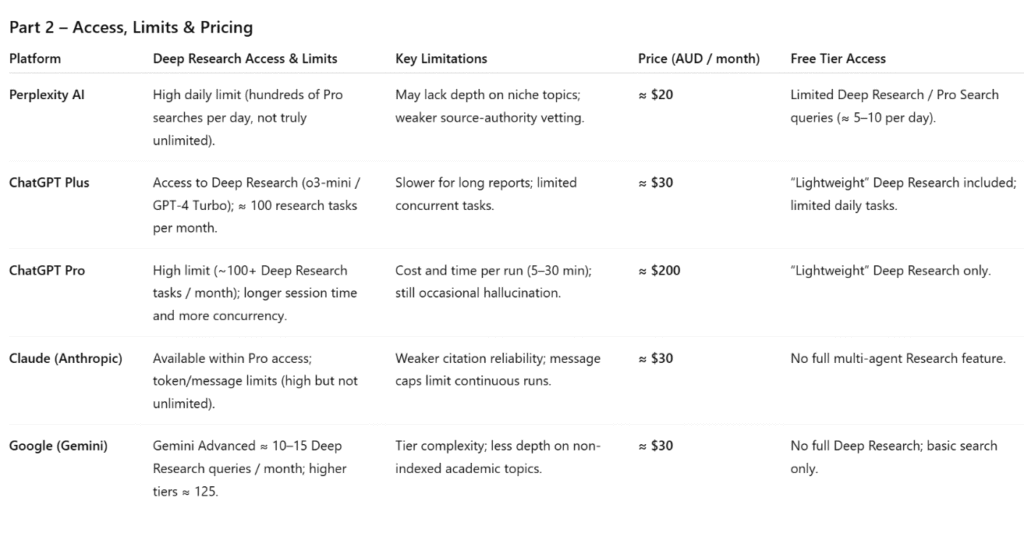
Still, it’s probably the best $30 you’ll spend all month.
Here’s why:
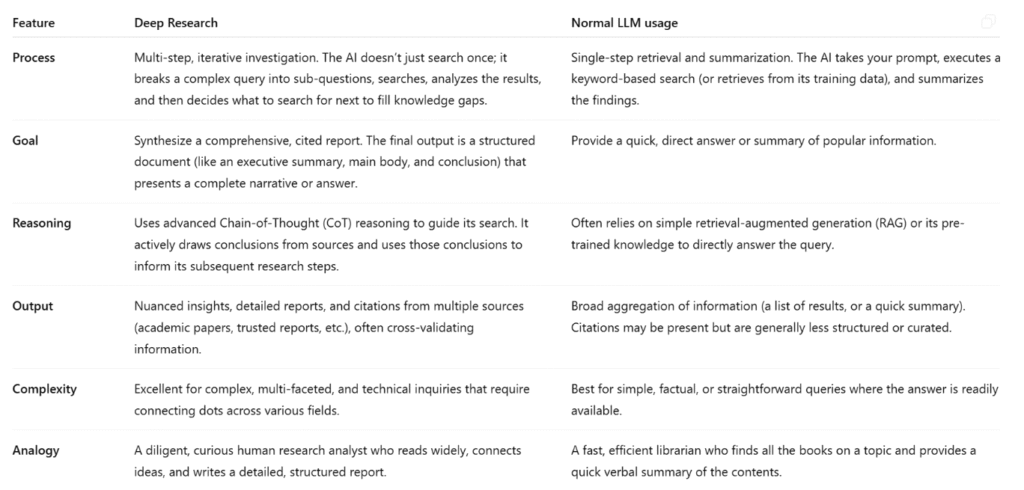
The Difference between Deep Research and “Normal AI”
Deep Research works like an analyst rather than a search bar. It plans an investigation, looks across multiple sources, cross-checks facts, and produces a cited summary you can audit. This process reduces errors, exposes how conclusions are formed, and helps connect information that single-step AI answers often miss.

Who is offering it and what are the Differences?
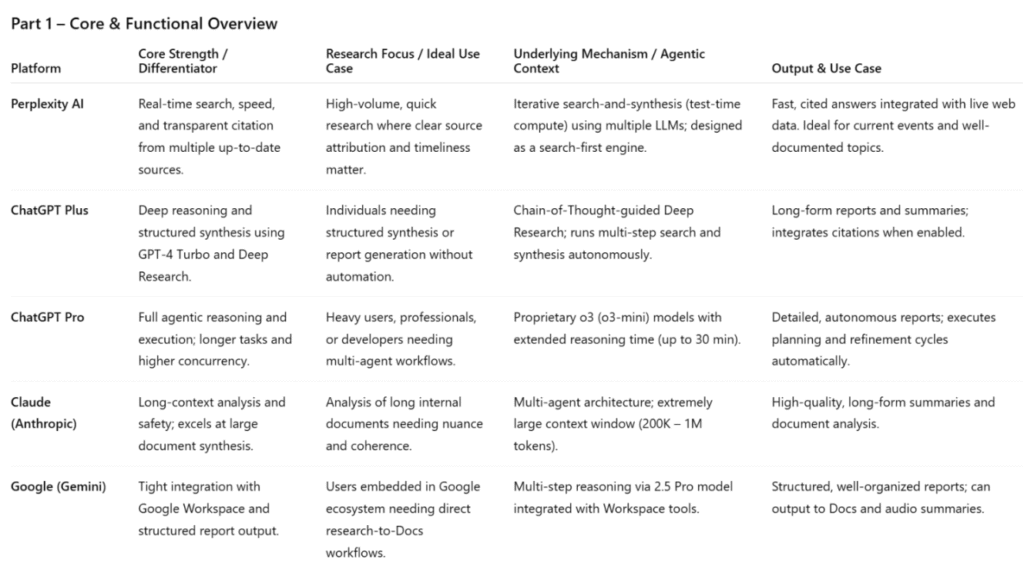
At a high level, all of the AIs can “research,” but they approach it from different angles. Focusing on Perplexity, ChatGPT, Claude and Gemini – the ones I use:
Perplexity is like a high-speed journalist. It hunts down facts in real time, cites everything, and delivers a concise, sourced answer in seconds. Perfect when you need trusted, recent information fast; less so when you’re exploring complex or theoretical topics.
ChatGPT Plus behaves more like a research assistant. It can take a topic, break it into sub-questions, and return a reasoned, structured report. The new Deep Research mode finally makes it feel like an analyst rather than a chatbot.
ChatGPT Pro moves from assistant to analyst. It can run long, multi-step investigations, reference multiple documents, and think for half an hour before handing you something that reads like a briefing note. It’s overkill for quick lookups but transformative for deep, multi-layered work.
Claude is the reflective one. It thrives on depth and context — you can feed it an entire report or legal contract, and it will actually read it, understand it, and summarise it with care. It’s less about speed, more about comprehension and tone.
Gemini is the pragmatic option for people who live in Google Workspace. Its Deep Research is well-structured and integrates directly into Docs and Gmail, which makes it a natural fit for teams — though it’s not yet as deep or flexible as OpenAI’s version.
In short:
- Perplexity = speed and transparency
- ChatGPT Plus = structured reasoning for individuals
- ChatGPT Pro = full-scale agentic research
- Claude = depth and long-context understanding
- Gemini = seamless integration into existing workflows
Differences between Perplexity, ChatGPT, Claude and Gemini (at two Glances)

Example: The Difference in Output (Gemini Deep Research vs. Gemini normal)
This was my prompt for both cases. Please note that these aren’t good prompts (use promptcowboy.ai, for instance, or ask the AI to refine it for you before going ahead)
- Elon mentioned on the tesla website there is math that it is possoble to power the entire earth with solar and batteries.
- Research this thesis in the most detail while also making sure you take note of the contrarian view. Try to keep the language in a way that a normal, albeit educated person can understand it
Standard Output: The Musk Thesis: The Math of Infinite Energy
Deep Research Output: The $10 Trillion Electrification Thesis: Feasibility, Friction Points, and the Path to a Sustainable Global Energy Economy
Even if you don’t want to read 18 pages instead of 4, it’s still worth running Deep Research first. Its iterative approach gives you higher-quality reasoning and broader coverage — just set a page limit and clear scope. I let it run freely here to show the difference when no boundaries are applied.
Cheers
Niklas