Last week it really hit me: we normalise astonishing things incredibly fast: What was science fiction five years ago is a footnote today.
We absolutely suck at putting things into perspective and being mindful of our own biases.
As I keep wrestling with what AI actually means for society, work, my family and my portfolio — trying to filter what’s doom and gloom and what’s hype — I realised how many things I completely take for granted that felt light years away only a few years ago.
Let’s take a step back and imagine it’s the start of 2010. Facebook was still two years away from going public (I vividly remember the debates: “But how are they going to monetise the users?” Unfortunately, I was a sceptic too—turned out bloody expensive…). Waymo didn’t exist yet. IBM’s Watson hadn’t even won Jeopardy! Go was considered unsolvable. Rockets couldn’t land themselves. Protein folding? Forget it. The first Iron Man movie was two years old; the second one pulled 47 million people into theatres worldwide. For most of them, Jarvis felt like pure science fiction.
Now, completely different story: all these things have happened or are underway (Jarvis). You have the vast knowledge of humankind at your fingertips, so that the the winning Jeopardy! really feels like a so what? So we normalise these massive achievements while failing to grasp their exponential effect and the profound impact they’ll have going forward.
And I—or the 46.9 million Iron Man 2 viewers who were also not fortunate enough to see through this—are not alone. It even happens to some of the most bullish voices to normalise huge changes, like Salim Ismail on the Moonshots podcast (link). The crew even called him out on it and it was certainly more a sign of something subconscious. To suggest Salim doesn’t think this technology is changing the world would be ridiculous—just look at the episode title: The Singularity Is Here. He’s also written brilliant books about exponential growth and organisations (Exponential Organizations 2.0: The New Playbook for 10x Growth and Impact). Highly recommend and will feature some ideas soon. It seems completely plausible to me that both the way of working and the structures of yesterday cannot be the structures and ways of tomorrow.
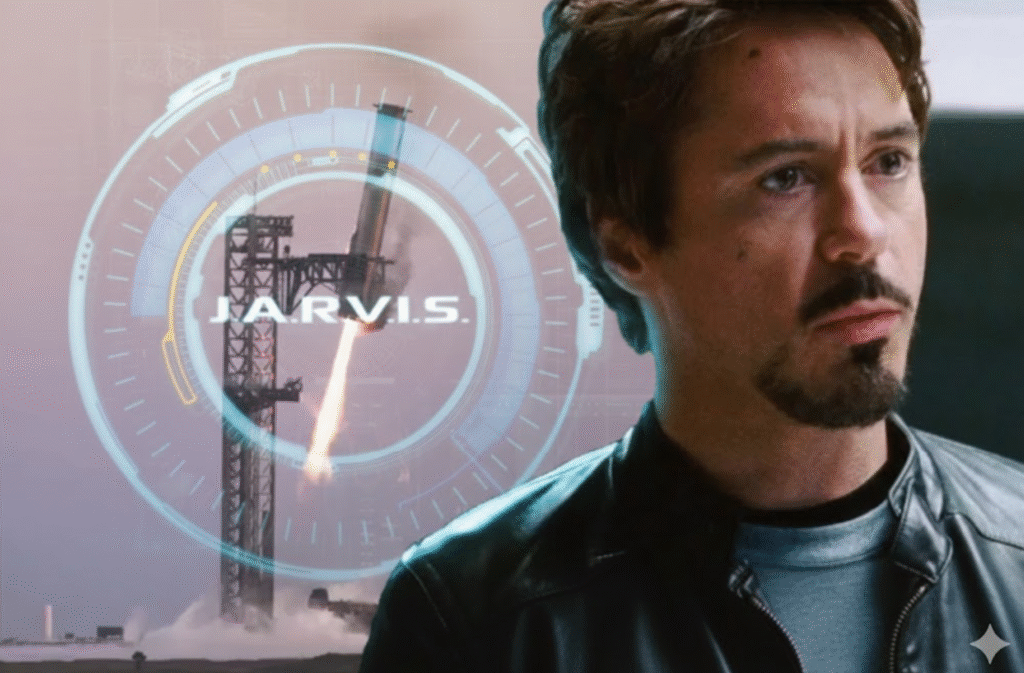
So, I figured there had to be more to it and dug a bit deeper. As I do these days, I had A VOICE CONVERSATION WITH ChatGPT (in my thick German-accented English—which meant no notetaker worked until last year. Jarvis, anyone?). We dug into biases:
Cognitive Biases That Warp How We See AI (and Change in General)
1. Present Bias We overvalue immediate rewards and undervalue future outcomes—even when the future ones are far more significant. This makes us dismiss slow-building, exponential shifts until they’re undeniable.
2. Normalcy Bias We assume things will keep working the way they always have, even when evidence points to dramatic change. It blinds us to how quickly the world is actually evolving.
3. Recency Bias We give more weight to recent events than to long-term trends, making it harder to recognise systemic shifts that take time to unfold.
4. Status Quo Bias We prefer things to stay the same, even when change could be beneficial. This resistance makes it harder to adopt or even acknowledge transformative technologies.
5. Cynicism Bias We tend to distrust or dismiss progress as hype or flawed—especially after past tech disappointments—causing us to underestimate genuine breakthroughs.
Interestingly, this path led me to Julian Schrittwieser’s article Failing to Understand the Exponential, Again (link).
Julian argues that we keep failing to understand the exponential because our intuition is linear while real technological progress compounds. We judge AI by its current flaws instead of its rate of improvement — assuming today’s limits will persist, just as many underestimated COVID’s spread in its early days.
His point is simple: if progress keeps doubling on schedule, the “plateau” people think they see is actually the calm before another sharp climb.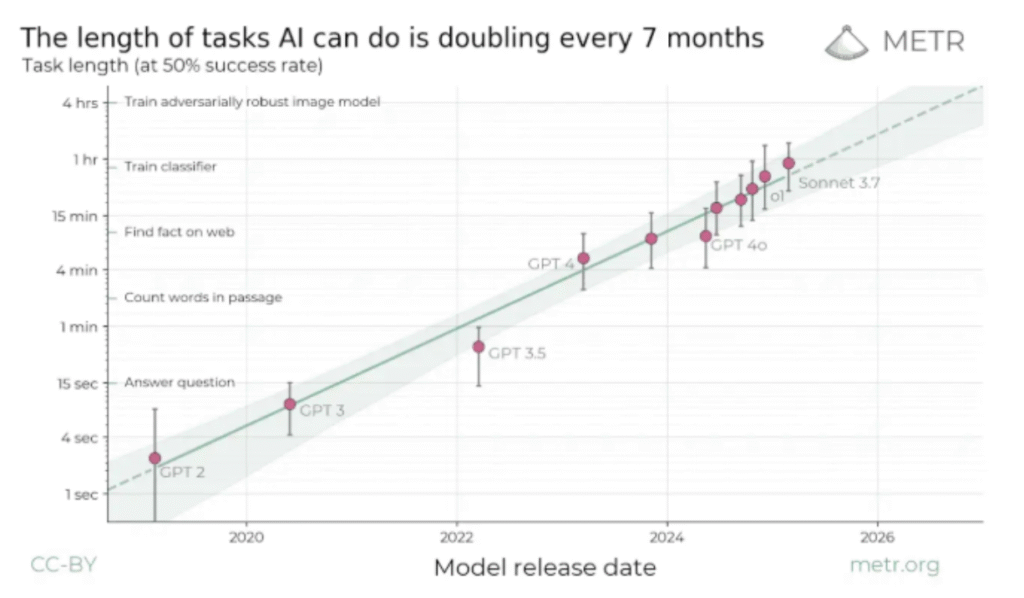
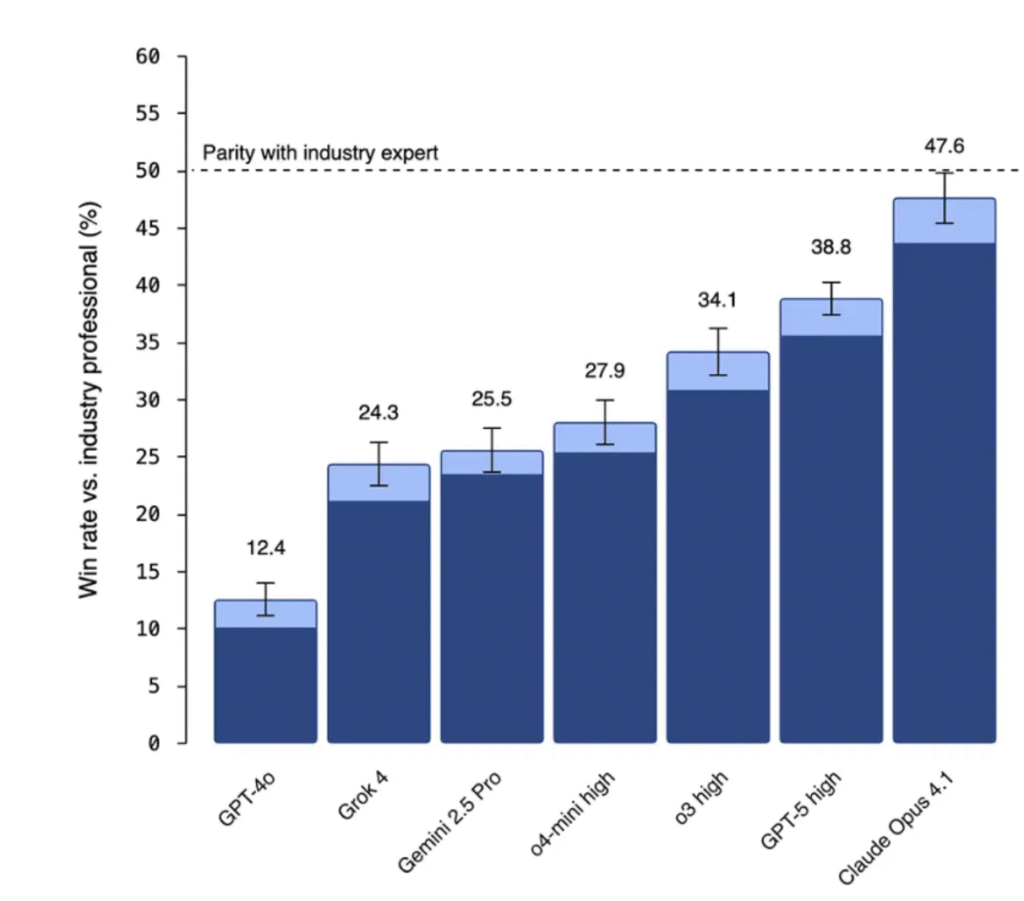
Julian, who was crucial among other things, on Google DeepMind’s Go team, concludes:
Given consistent trends of exponential performance improvements over many years and across many industries, it would be extremely surprising if these improvements suddenly stopped. Instead, even a relatively conservative extrapolation of these trends suggests that 2026 will be a pivotal year for the widespread integration of AI into the economy:
- Models will be able to autonomously work for full days (8 working hours) by mid-2026.
- At least one model will match the performance of human experts across many industries before the end of 2026.
- By the end of 2027, models will frequently outperform experts on many tasks.
It may sound overly simplistic, but making predictions by extrapolating straight lines on graphs is likely to give you a better model of the future than most “experts” – even better than most actual domain experts!”
Here is a podcast with him explaining this further.
Azeem Azhar and Hannah Petrovic, PhD analysis on the 99% step-length—the number of sequential actions an AI can reliably take without human intervention—adds to this projection by suggesting this metric will grow exponentially, doubling roughly every seven months as per the METR analysis. This trend indicates that current frontier systems capable of around 100 steps at 99% reliability could reach 37,000 to 120,000 steps by 2030-2031, enabling them to autonomously execute complex, VP-level strategic projects.
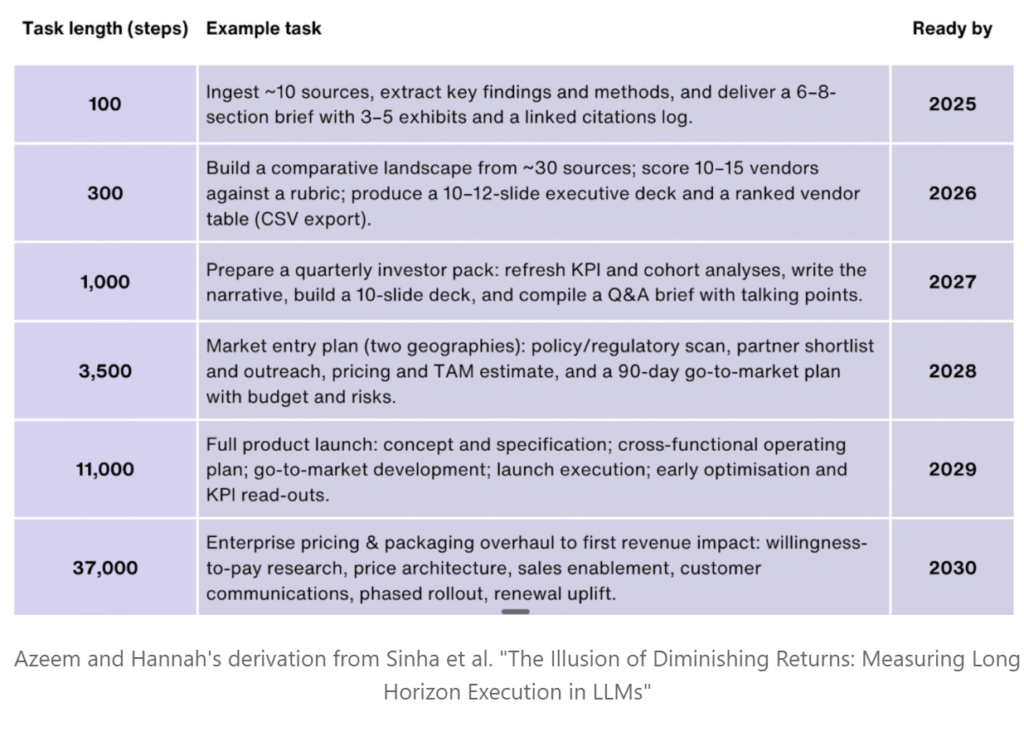
I think Azeem and Hannah’s illustration makes the timelines tangible — it helps frame how early we still are. Some of the hype around current breakthroughs misses that point: these improvements matter, but they’re still just stepping stones toward what’s coming next. And if you and your business aren’t 100% AI yet, you are the very much in the middle of the pack. (However, it is probably time to really understand the implications on competitive position, your industry and your processes rather sooner than later).
Also, you should subscribe to Azeem’s substack – it’s absolutely brilliant.
Wanting to understand implications on productivity even more, I asked Claude to prepare a few growth scenarios based on deep research into what leading organisations incl. the OECD, Goldman and McKinsey predict—then added additional scenarios by cutting the numbers by 50 % and adding acceleration. Even in the 50% cut – scenario Claude called “ultra-conservative,” the productivity gains were significant. The other cases basically imply a productivity explosion.
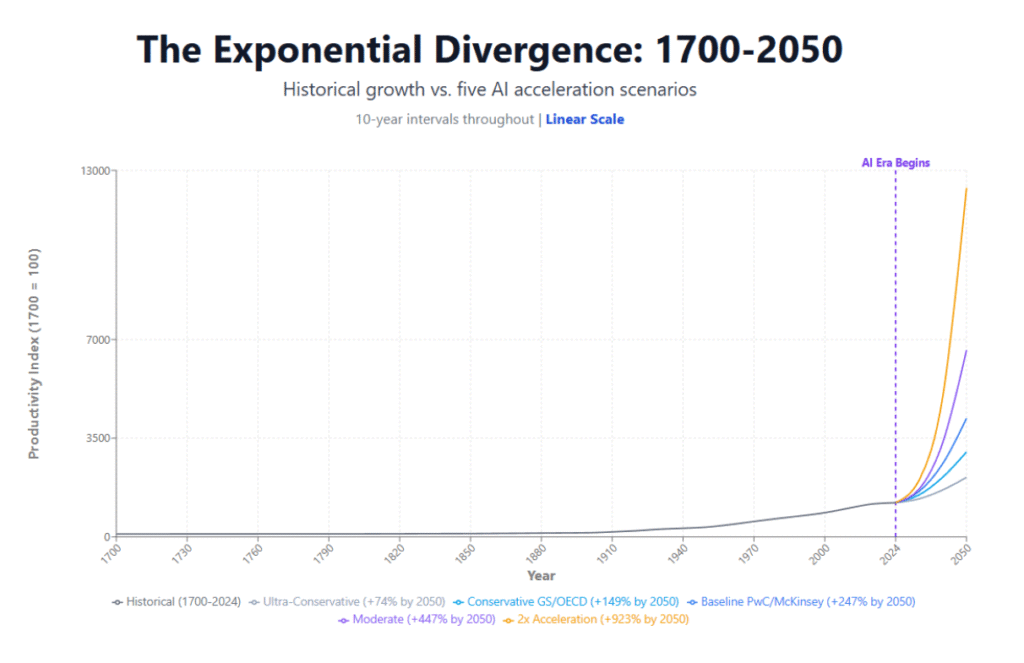
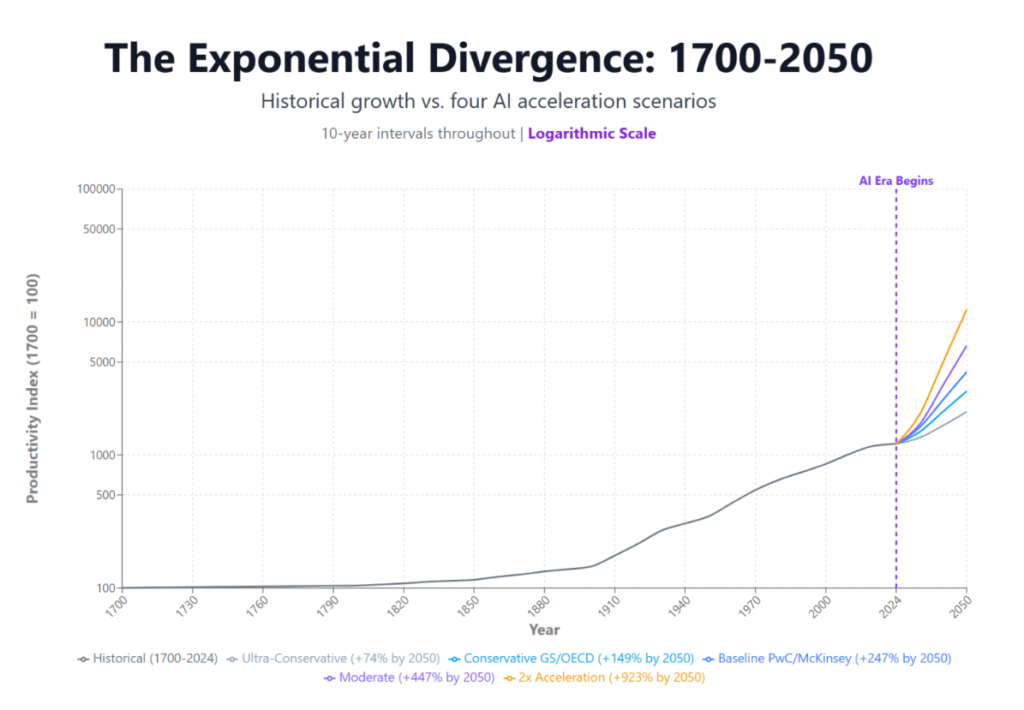
And of course linear charts can be misleading, so here it is in logarithmic format. Even logarithmic, the most conservative assumptions re-ignites trend that started in the early 1900s, but all other cases take the productivity to absolutely different levels.
We have to be careful not to mix up lab capabilities with what is happening in the real world; Often, regulation, liability, trust, capital requirements, infrastructure needs and other factors push out implementations. We can see this kind of resistance both in terms of regulations for self-driving cars (even though with millions of miles driven it appears to be clearly safer than humans driving) and looking at the sheer capital requirements we need to get mass market AI to the levels the models are theoretical possible while finding a monetization path to fund all of these on the application layer.
However, he change is undeniable, even if most companies—and people like me—are still figuring out the best use cases and ROI. For me, things have accelerated dramatically. I’m working in completely new ways compared to just six or twelve months ago. It’s not only about which tools I use but also how I use them—more voice, less keyboard. With new operating systems and browsers, that shift will completely change how we interact with computers – reshaping the very modality of work. That said, I’m still dabbling—testing, failing, and wasting days on wrong turns. But that’s a story for another day.
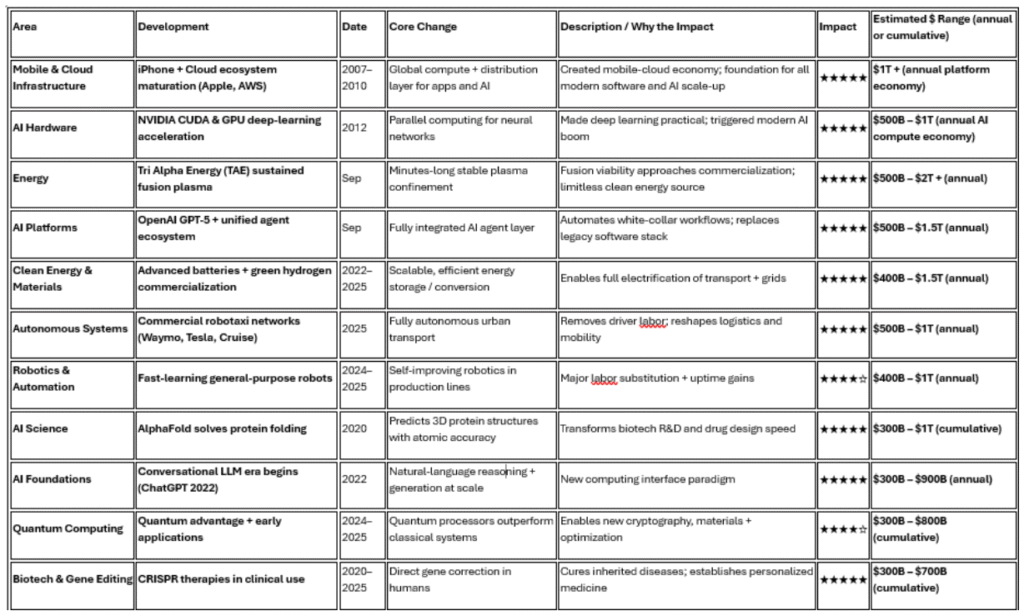
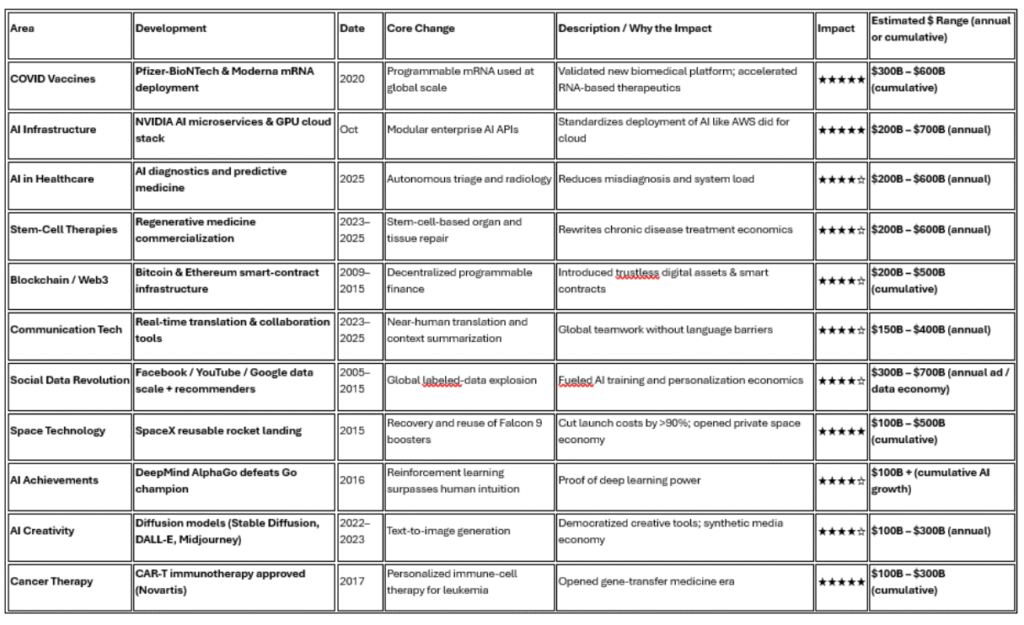
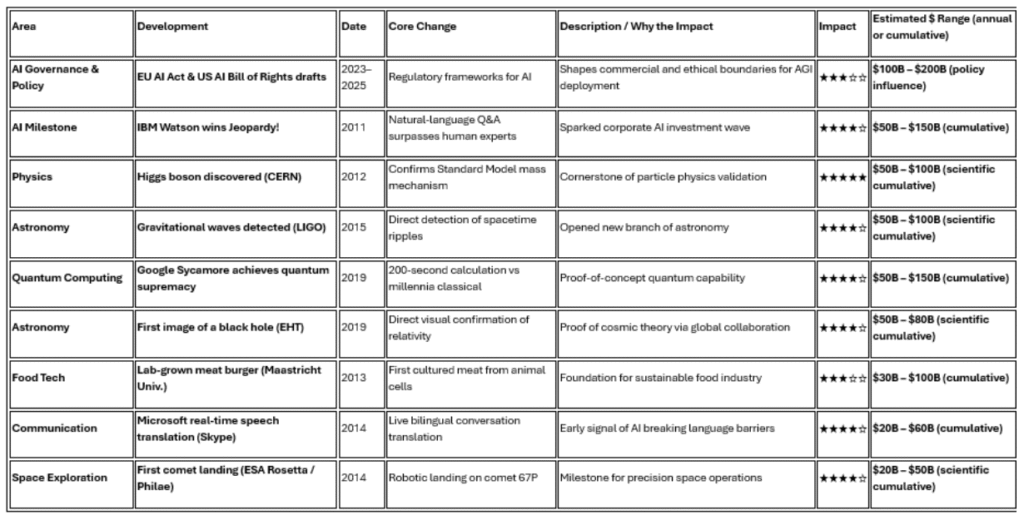
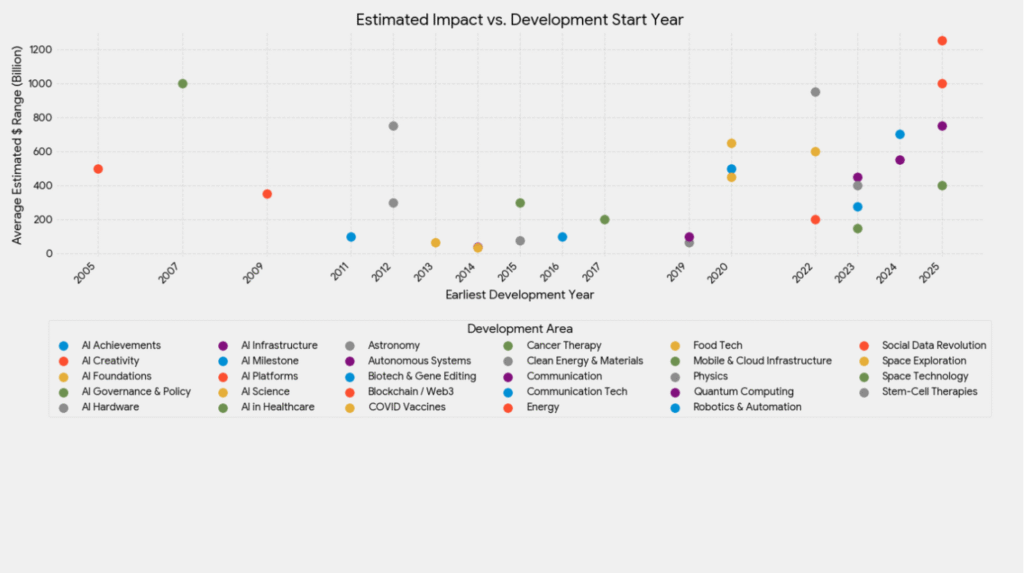
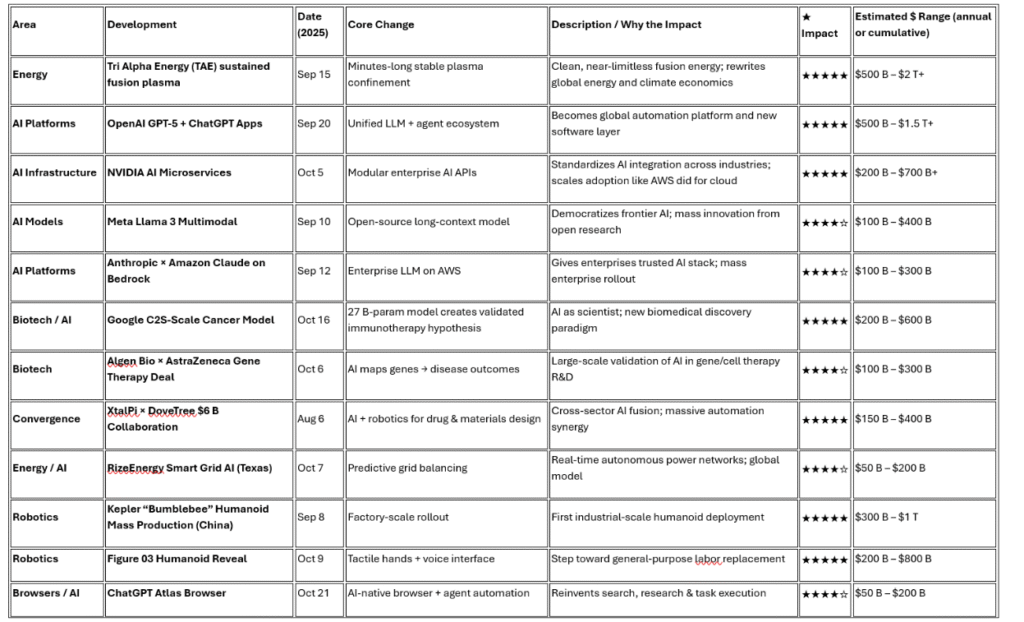
I am by no means capable of saying whether this trend will continue and what is technically possible, how many billions or trillions will be sufficient. Like most of the world, I’m just trying to keep up—and maybe find a small edge. That’s why I think in frameworks and learn from people smarter than me. However if I look at the developments in the table of last 13 weeks below it doesn’t feel like it’s slowing down to me. It is also clear that a lot of major breakthroughs have happened in the last few years of the last 15 years supporting the thesis of exponential gains.
Also, while I am not sure if Prince Harry and Meghan know more about the topic, some of the people having singed the latest initiative against ASI certainly do.
So, what’s next? According to Elon all jobs will be replaced and working will be optional. Will he be right? I don’t know. Will this happen tomorrow? Certainly not. Are those timelines from above a good indication? I think so.
My takeaway is for today is that it is insanely hard for us to grasp change and considering all I know and experience today, it’s happening and it’s happening faster than ever.
References (Scroll down for tables of developments in the last 13 weeks and since 2010):
Main Sources:
Azhar, A and Petrovic, H. (2025) “The Only AI Curve That Matters” Exponential View https://www.exponentialview.co/p/the-only-ai-curve-that-matters
CNBC (22.10.2025): Hundreds of public figures, including Apple co-founder Steve Wozniak and Virgin’s Richard Branson urge AI ‘superintelligence’ ban https://www.cnbc.com/2025/10/22/800-petition-signatures-apple-steve-wozniak-and-virgin-richard-branson-superintelligence-race.html
Ismail, S., Diamandis, P.H., & Malone, M.S. (2023) “Exponential Organizations 2.0: The New Playbook for 10x Growth and Impact” Diversion Books https://www.amazon.com/Exponential-Organizations-2-0-Playbook-Growth-ebook/dp/B0C6YGMDVW
Moonshots (21.10.2025): The Singularity is Here: AI is Solving Math, Sora Outpaces Chat-GPT & AI is Designing Chips | EP#201 https://www.youtube.com/watch?v=VfwNK9OVsrM)
Sinha, A., et al. (2025) “The Illusion of Diminishing Returns: Measuring Long Horizon Execution in LLMs” arXiv:2509.09677 https://arxiv.org/abs/2509.09677
Shrittwieser, Julian. (2025) “Failing to Understand the Exponential, Again” https://www.julian.ac/blog/2025/09/27/failing-to-understand-the-exponential-again/
The MAD Podcast with Matt Turck (24.10.2025): Are We Misreading the AI Exponential? Julian Schrittwieser on Move 37 & Scaling RL (Anthropic) https://www.youtube.com/watch?v=gTlxCrsUcFM)
Historical Productivity Data – Below Sources provided by Claude for the Scenarios. I clicked on them, they seem to be legit and the productivity charts are in line with what is usually shown
Maddison Project Database (2020) University of Groningen https://www.rug.nl/ggdc/historicaldevelopment/maddison/
Gordon, R.J. (2016) “The Rise and Fall of American Growth: The U.S. Standard of Living since the Civil War” Princeton University Press https://press.princeton.edu/books/hardcover/9780691147727/the-rise-and-fall-of-american-growth
Conference Board Total Economy Database https://www.conference-board.org/data/economydatabase/total-economy-database-productivity
Conservative Scenario Sources
Goldman Sachs (2023) “The Potentially Large Effects of Artificial Intelligence on Economic Growth” https://www.goldmansachs.com/intelligence/pages/generative-ai-could-raise-global-gdp-by-7-percent.html
Goldman Sachs (2024) “Gen AI: Too Much Spend, Too Little Benefit?” https://www.goldmansachs.com/insights/articles/gen-ai-too-much-spend-too-little-benefit
OECD (2023) “OECD Employment Outlook 2023: Artificial Intelligence and the Labour Market” https://www.oecd.org/employment/outlook/
IMF (2024) “Gen-AI: Artificial Intelligence and the Future of Work” IMF Working Paper WP/24/1 https://www.imf.org/en/Publications/Staff-Discussion-Notes/Issues/2024/01/14/Gen-AI-Artificial-Intelligence-and-the-Future-of-Work-542379
Baseline Scenario Sources
PwC (2017) “Sizing the Prize: What’s the real value of AI for your business and how can you capitalise?” https://www.pwc.com/gx/en/issues/data-and-analytics/publications/artificial-intelligence-study.html
McKinsey Global Institute (2023) “The Economic Potential of Generative AI: The Next Productivity Frontier” https://www.mckinsey.com/capabilities/mckinsey-digital/our-insights/the-economic-potential-of-generative-ai-the-next-productivity-frontier
McKinsey (2024) “The State of AI in 2024: Gen AI’s Breakout Year” https://www.mckinsey.com/capabilities/quantumblack/our-insights/the-state-of-ai
Accelerated Scenarios – Academic Research
Brynjolfsson, E., Li, D., Raymond, L. (2023) “Generative AI at Work” NBER Working Paper 31161 https://www.nber.org/papers/w31161
Noy, S., Zhang, W. (2023) “Experimental Evidence on the Productivity Effects of Generative Artificial Intelligence” Science, 381(6654), 187-192 https://www.science.org/doi/10.1126/science.adh2586
Dell’Acqua, F., et al. (2023) “Navigating the Jagged Technological Frontier: Field Experimental Evidence of the Effects of AI on Knowledge Worker Productivity and Quality” Harvard Business School Working Paper 24-013 https://www.hbs.edu/ris/Publication%20Files/24-013_d9b45b68-9e74-42d6-a1c6-c72fb70c7282.pdf
Brookings Institution (2024) “How AI Will Transform the Global Economy” https://www.brookings.edu/articles/how-ai-will-transform-the-global-economy/
Stanford HAI (2024) “Artificial Intelligence Index Report 2024” https://aiindex.stanford.edu/report/
Supporting Research
Eloundou, T., et al. (2023) “GPTs are GPTs: An Early Look at the Labor Market Impact Potential of Large Language Models” OpenAI & University of Pennsylvania https://arxiv.org/abs/2303.10130
Korinek, A., Stiglitz, J.E. (2021) “Artificial Intelligence and Its Implications for Income Distribution and Unemployment” NBER Working Paper 24174 https://www.nber.org/papers/w24174
Agrawal, A., Gans, J., Goldfarb, A. (2022) “Power and Prediction: The Disruptive Economics of Artificial Intelligence” Harvard Business Review Press https://www.hbs.edu/faculty/Pages/item.aspx?num=62384
Also Claude: “All URLs were verified and these sources represent the primary research and institutional forecasts used to construct the five scenarios in the productivity charts.”
Full tables – Disclaimer: Take the estimates with a pinch of salt. Noone knows, neither I nor ChatGPT.
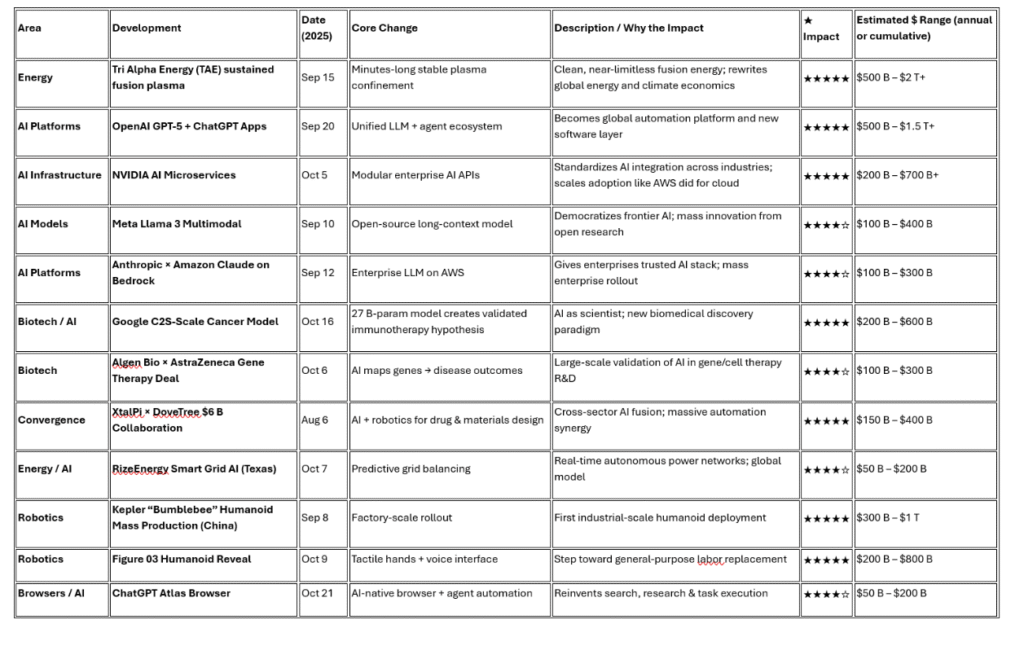
Finally, here is the full table of break-through achievements since 2010